
Indices can make a difference | RS-EO-SatApp-1.3.3
Each of the numerous indices available for use in determining burn severity has advantages of its own.
Normalized Difference Vegetation Index (NDVI)
Healthy vegetation reflects near-infrared light (NIR) and absorbs red light. Dry, dehydrated places without any greenery do not do this. This ratio is indicated by the NDVI as a value between -1 and +1. At high values there is more green, at low values less green. In a forest environment, this index is useful to determine the locations of fire scars.
Green plants reflect much of the near infrared light and very little of the red light, while brown plants reflects more red light and less near infrared light. By taking the ratio of red and near infrared reflectance an index of vegetation “greenness” can be defined: A low NDVI value indicates the plant is brown, while a high NDVI value indicates the plant is green.
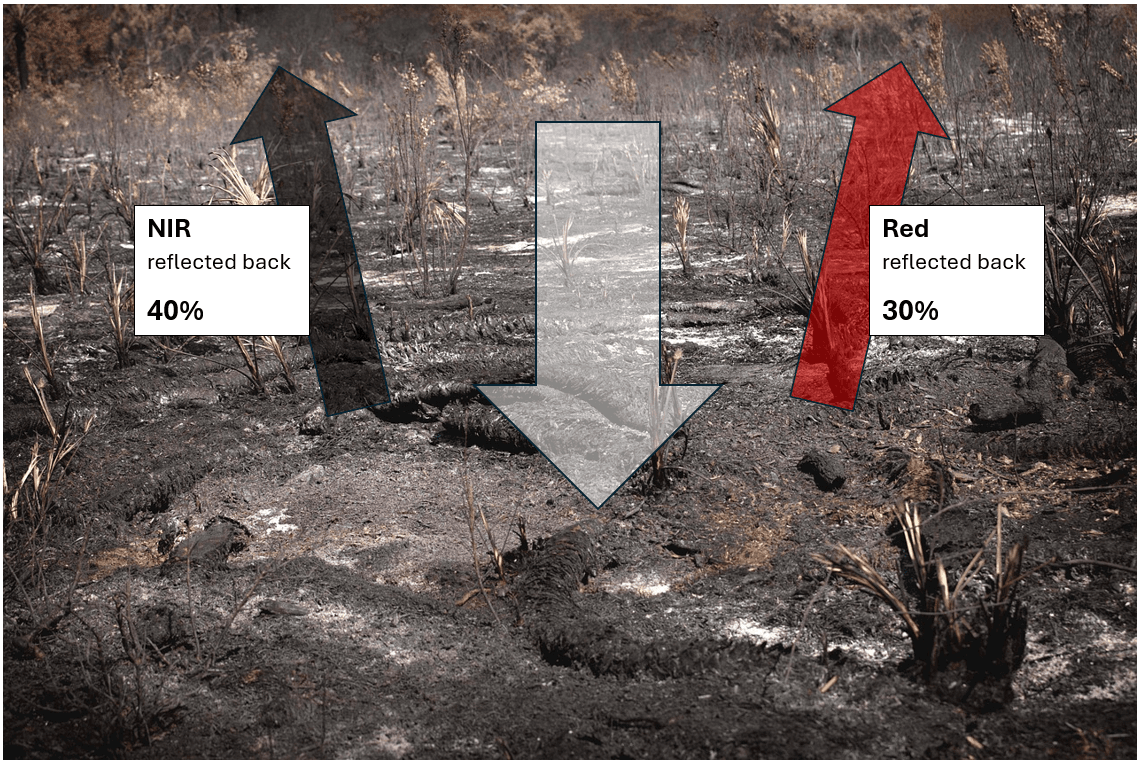
EXAMPLE: A burnt area absorbs only a small part of the incoming red light and reflects 30 % of it back. Also, it only reflects around 40% of the near infrared radiation (NIR).
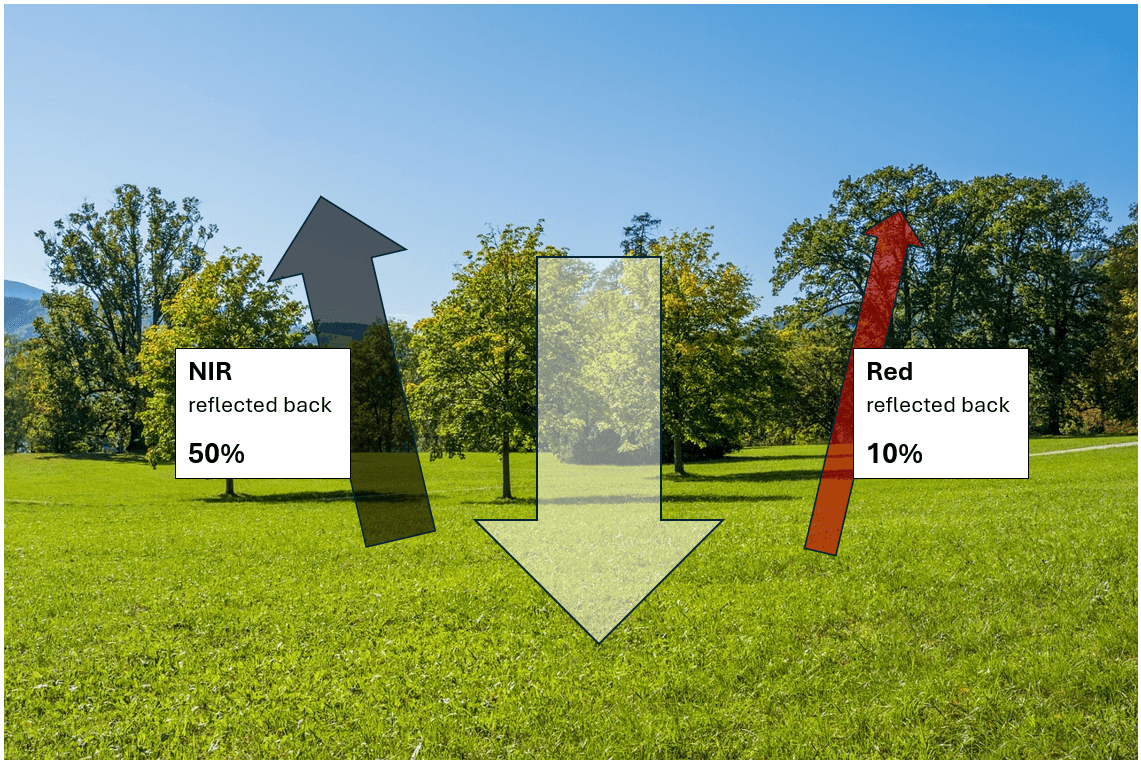
By comparison, a healthy forest might absorb all but 10% of incoming red light, and reflect 50% of NIR light.
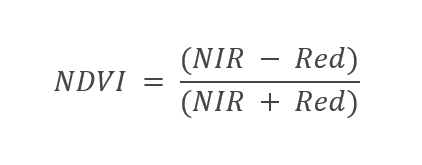
If we take the proportion of radiation that is reflected in the red and NIR regions of the electromagnetic spectrum, we can distil the information contained in this data. To do this, we use a simple formula:
For the example above, we would get:
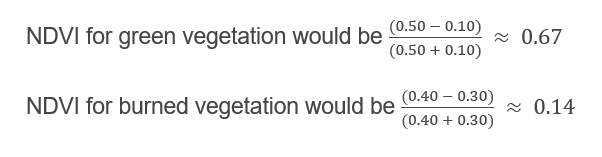
We can see that the NDVI is markedly higher for healthy vegetation than for a burnt area.
Normalized Difference Moisture Index (NDMI)
Like the NDVI, the NDMI also compares the proportion of radiation reflected from the ground in two different wavelength ranges. This time it is not the red and the NIR (near infrared) range of the electromagnetic spectrum, but the SWIR (shortwave infrared) and the NIR range of the electromagnetic spectrum.
NIR light and SWIR light correspond to the first “atmospheric window” and the second “atmospheric window” – which means that SWIR has the longer wavelength than NIR.
This ratio shows the amount of water held in the vegetation in the area under analysis. It can be used to assess burn severity because healthy vegetation with an adequate amount of water reflects NIR, while absorbing SWIR. Higher values mean the vegetation is healthy and contains water, while low values are areas that have dry vegetation or no vegetation at all.
Normalized Burn Ratio (NBR)
The NDVI and the NDMI were initially designed for agricultural use, but the NBR index is specifically for assessing burn severity. It is one of the most commonly used indices in wildfire remote sensing. The formula is the same as the NDMI or the NDVI, but uses a different section of the SWIR band that is more specific to wildfire applications. Like the other two ratios, the lower the NBR, the greater the burn severity.
Delta indices (such as dNBR, dNDMI, dNDVI)
We are often interested in the difference between before and after an event – such as a wildfire. The respective difference value is calculated for this purpose.
Delta indices are used to show change over time. Analysts use pre- and post-fire images to assess burn severity and show the amount of change caused by a fire. Any of these indices can be used as delta indices. Higher values mean there is large amount of change between the two images.