
Questioning and Creating Hypotheses About Local Air Quality
After being introduced to the topic students might naturally come up with questions such as “Is air quality good within school and the classroom?” and “Is air quality poor on the street and how does it compare with the local park?”, etc.
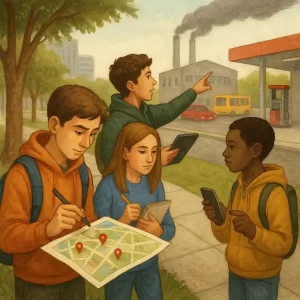
Investigating Air Pollution Sources and Formulating Research Questions.
Illustration of students exploring their local environment to identify and map potential air pollution
sources, using tools such as paper maps, tablets, and smartphones. The scene highlights observation,
collaborative inquiry, and the development of hypotheses about air quality variations across locations.
Credits: Custom educational illustration created for the course
Air Quality Exploration: Understanding the Invisible World We Breathe, generated by an AI model..
Initial exploratory outdoor activities might also help them formulate questions. For instance, a simple walk around the school to observe and map possible air pollution sources such as car and bus exhaust, factory smoke, construction dust, tire and brake particles, gas fumes from fuel stations, burning trash, and cooking smoke from nearby food stalls, etc.
Use google maps or a similar tool to pin them and describe them. This will help visualize where it is more appropriate to measure air quality, and what kind of pollution is expected at these locations.
Let students ask questions, discuss and organize themselves into groups of students with similar research interests.
Each group is now tasked with developing a hypothesis regarding air quality. If validated, these hypotheses could guide and impact the formulation of more environmentally friendly local policies and practices.
Example hypothesis:
- Traffic congestion and greenhouse gas emissions are highest during rush hour compared to other times of the day.
- Air quality is poorer inside the classroom when the windows are kept closed during lessons.
- Rainy days show better air quality than dry, sunny days.