
GEO-Labs: Nature-based Solutions for Saving Your City (Challenge-based, secondary level)
🌿 Introduction to the Lesson
Welcome to an exciting challenge-based learning experience where you become the urban planner, working to transform your city into a cooler, greener, and more resilient place to live. In this project, your mission is to protect your city, for example, Athens, Vienna, Sofia, Paris, or wherever you arefrom the growing impacts of climate change using Nature-based Solutions. During this activity you and your students will:
✅ Discover the power of Nature-based Solutions (NbS) in urban planning
✅ Learn how to assess Urban Heat Risk using printed maps and online tools
✅ Collaborate with experts, researchers, and policymakers in a Living Lab environment
✅ Use NbS Cards to unlock innovative strategies and ideas for prototypes
✅ Make informed, budget-conscious decisions that benefit both people and the planet
You’ll begin by analyzing your city’s Urban Heat Risk using printed maps and tools like My Google Maps and Web GIS platforms. Then, you’ll explore different NbS Cards, each representing a nature-based intervention such as urban forests, green roofs, permeable pavements, or pocket parks. These cards come with challenges and prototyping ideas to enhance your project.
But you’re not alone! You’ll form a team by selecting external societal actors, such as NbS experts, city planners, researchers, or local policymakers—who will guide you. Just like in real-world planning, you’ll need to balance your decisions with a budget, choosing the right solutions and support while maximizing environmental and social impact.
This Living Lab approach empowers students to think critically, collaborate meaningfully, and engage with real-world sustainability challenges in an interactive, creative, and strategic way.
Are you ready to save your city and shape a greener future? Let the NbS challenge begin! 🌳🏙️♻️💡
What Nature – based Solutions (NbS) are?
Nature-based solutions (NbS) are inspired and supported by nature, they are cost-effective, simultaneously provide environmental, social and economic benefits and help build resilience; such solutions bring more, and more diverse, nature and natural features and processes into cities, landscapes and seascapes, through locally adapted, resource-efficient and systemic interventions. NBS must benefit biodiversity and support the delivery of a range of ecosystem services [1].
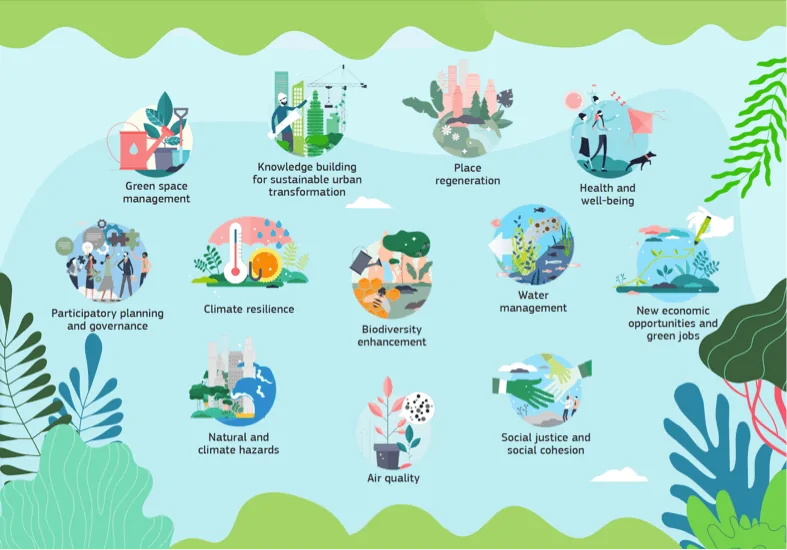
Image source: UpSurge Project
NbS address societal challenges through actions to protect, sustainably manage, and restore natural and modified ecosystems, benefiting people and nature at the same time. They target major challenges like climate change, disaster risk reduction, food and water security, biodiversity loss and human health, and are critical to sustainable development.
The design, implementation, and evaluation of Nature-based Solutions are supported by the IUCN Global Standard for Nature-based Solutions. The Global Standard helps users shape their solutions and make them truly effective through 8 criteria and 28 indicators, supported by guiding questions [2].
✅ Nature-Based Solutions (NbS) as Catalysts for Education for Sustainable Development
Integrating Nature-based Solutions (NbS) into teaching plays a vital role in advancing Education for Sustainable Development (ESD). By connecting students with real-world environmental challenges, NbS-based learning cultivates not only knowledge but also essential 21st-century skills such as critical thinking, creativity, and systems thinking.
NbS activities inspire students to reimagine urban and natural spaces through the lens of sustainability. When learners explore concepts like green infrastructure, urban forests, green roofs, or ecosystem restoration, they begin to understand how nature can be part of the solution to climate, health, and social challenges. This kind of education nurtures imaginative thinking and creative problem-solving. Through hands-on, project-based learning, students can prototype their own ideas, make informed decisions, and collaborate as change-makers—envisioning and designing a more resilient and inclusive future for their cities and communities.
Nature-based learning not only makes sustainability tangible but also empowers the next generation to think differently, act responsibly, and embrace the co-benefits of working with nature.
✅ Access to Comprehensive Educational Resources
Educators have access to a wealth of resources to integrate NbS into their teaching:
- NbS EduWorld: Offers a comprehensive repository of educational materials, including guidance, reports, and tools developed around NbS education [3].
- NetworkNature: Provides a platform for the NbS community, offering resources and key recommendations for policymakers and educators [4].
- European Schoolnet Academy: Features courses like “Exploring Nature-Based Solutions in Your Classroom,” aimed at helping teachers integrate NbS into their curricula [5].
- NBS Academy: A European hub for integrating NbS into teacher education, promoting innovative and transferable programs on NbS education [6].
By incorporating NbS into education, students not only learn about environmental science but also develop a sense of responsibility and empowerment to contribute to sustainable solutions in their communities. Embracing NbS in educational settings equips students with the knowledge and skills necessary to address environmental challenges creatively and effectively, paving the way for a more sustainable future. Let’s explore one of the activities developed for NbS EduWorld project as part of the NbS Living Labs activities!
📌 Integrating Nature – based Solutions (NbS) to Athens
Skills Labs of Ellinogermaniki Agogi, 7th Grade, Loukas Katikas (NTUA) & Alexandros Pantazis (Ellinogermaniki Agogi)
This is a step-by-step approach for teachers to engage 7th-grade students in a comprehensive NbS project using the Living Lab methodology. It combines theoretical understanding, problem identification, solution ideation, collaborative efforts, and reflection, fostering a hands-on learning experience focused on sustainability and environmental problem-solving.
🕒 Timeframe & Format
This is a challenge-based activity designed to unfold over approximately 15 to 16 hours of classroom and outdoor engagement. It’s structured to encourage deep exploration, creativity, and collaboration, mirroring a real-world urban sustainability project. During this time, students will:
- Learn about urvan sustainability and NbS
- Investigate urban heat risk using spatial tools and printed maps
- Experiment on NbS and how they protect cities from heatwaves and floods
- Explore and compare a range of NbS through interactive cards
- Select appropriate NbS concepts, and societal actors within a set budget
- Design and present their own nature-inclusive strategies and prototyping ideas for urban resilience
The flexible format makes this activity ideal for interdisciplinary teaching and learning blocks focused on climate action, geography, citizenship, and STEAM education. Here is the project structure:
Lesson 1 (45 minutes): Motivational warm-up
Introduction (10 minutes)
Students write what they first think about when they hear the term smart city. Then, they discuss the results with the teacher. To guide the discussion, the teacher could ask the following questions:
- Think about a city you’ve visited. What did you like about it?
- Now think about a city you did not enjoy visiting. What were the issues?
- When do you feel a city is “smart”, or “efficient”?
- Name some “smart” characteristics of your favourite city.
Warm-up on NbS (20 minutes)
Then, the teacher asks the students if they have ever heard about Urban Sustainability and Nature-based Solutions. Students write down how they imagine how cities are linked to Nature-based Solutions. Students watch first the following videos:
- Introduction video (3 minutes):
- Urban Nature-based Solutions: What are they and why are they so important? (Link)
- Heatwaves and NbS (2 minutes)
- Urban Heat Island Effect and NbS (Link)
- Floods and water storage management and NbS (7 minutes)
- Sustainable Cities: Nature-Based Solutions in Urban Design, Floods Mitigation (Link)
Discussion (10 minutes)
Split the class into two groups (2 minutes):
- Team A (in favor of NbS) and Team B (against NbS).
Opening Statements (2 minutes each team):
- Team A presents arguments in favor of NbS, emphasizing its benefits in mitigating environmental challenges.
- Team B presents arguments against NbS, highlighting potential drawbacks or limitations.
Rebuttal (3 minutes each team):
- Teams respond to each other’s opening statements, challenging the presented arguments.
- Encourage students to use evidence and examples to support their points.
Lesson 2 (45 minutes): Meet an NbS expert – Define the challenge.
Teachers can use the following resources and the StoryMap to spark curiosity and meaningful discussion in the classroom:
- Athens ‘on fire’ – Thermal cameras (video 1)
- Athens ‘on fire’ – Thermal cameras (video 2, temperature differences picture)
- Athens ‘on fire’ – Thermal cameras (video 3, with temperature scale bar)
- Car temperatures – Heatwave (Link, pictures with temperature values)
🎥 ArcGIS StoryMap – Nature-based Solutions for Cities
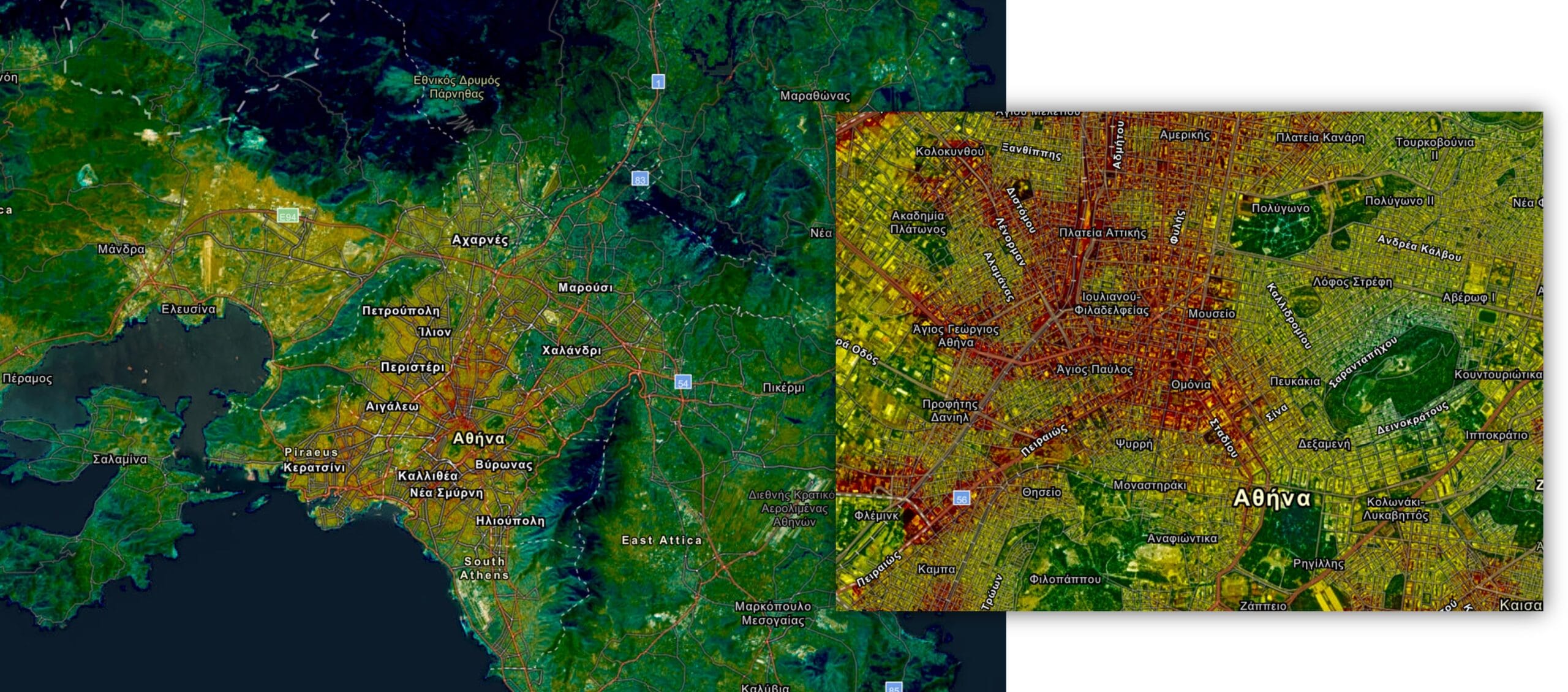
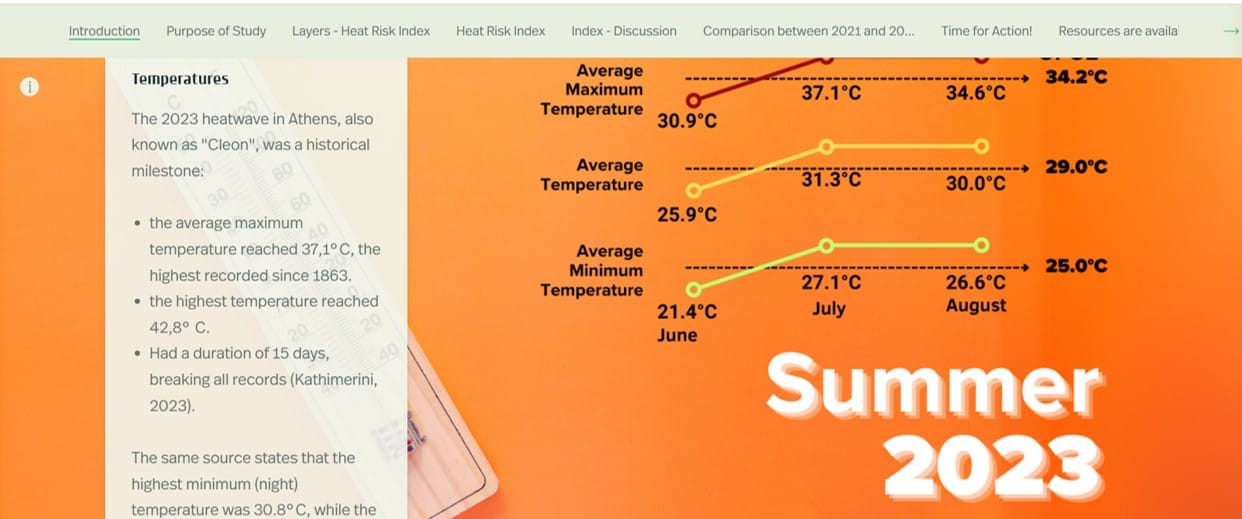
This interactive StoryMap visually explains (see the images above) the importance of Nature-based Solutions (NbS) in making cities more resilient to heatwaves, and climate change. Through real-world examples, maps, and animations, it helps students understand and contextualize the problem for the city of Athens by answering the following questions:
✅ Why urban areas are vulnerable to climate extremes?
✅ How experts and researchers are analyzing heatwaves and risks?
✅ What type of data are they using and how are they monitoring Heat Island Effects?
You may also use the following map and research work for the flood risk in your city. Here is an example for Athens Metropolitan area:
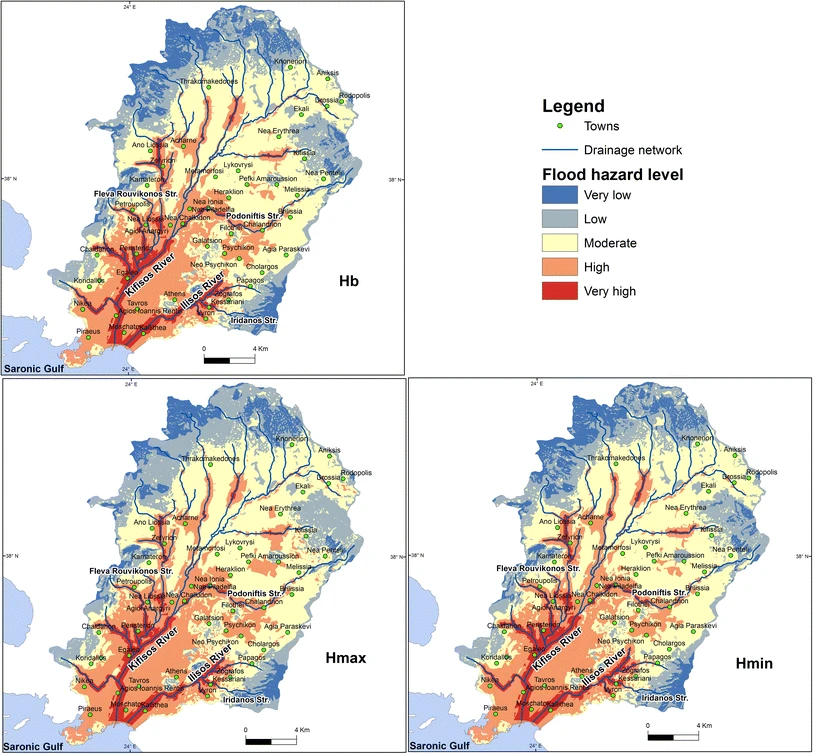
Image source: Bathrellos et al. (2016). Urban flood hazard assessment in the basin of Athens Metropolitan city, Greece. Environ Earth Sci 75, 319
Or you may use maps from the following links:
- Floods Risk event – Athens (in Greek, Link 1, Link 2)
- Athens Social Atlas: Natural hazards and climate change risks in Athens
- Bournas and Balta (2025): Flood Hazard Assessment Using Weather Radar Data in Athens, Greece. Remote Sensing, 17(1), 72.
By exploring the examples related to heatwaves and floods, students begin to develop an initial understanding of which areas are most vulnerable to climate change impacts and why these risks vary across different urban environments.
👩🏫 Invite an NbS Expert to Your Class
To deepen the experience, consider inviting a Nature-based Solutions expert, environmental planner, or city official to:
- Present local and regional problems and challenges related to climate crisis
- Present local, national or internation NbS projects
- Share the challenges and benefits of implementing NbS in real life
- Answer students’ questions and provide feedback on their own NbS ideas
This interaction will not only enrich the project with real-world insights but also give students a unique opportunity to connect with external actors and professionals in sustainability, strengthening the Living Lab approach.
Lessons 3 & 4 (70 – 80 minutes): Brainstorming and experimenting on the topic of NbS
Activity 1 (Optional): Intro to NbS (10 minutes): Students have a handout with the context of an article for an in-depth understanding of the concept (see in Annex 1). Working with subject-specific vocabulary (i.e. Fires, Heatwaves, Floods, GDP, CO2 etc.) and helping to understand the core of the article and the examples presented from different parts of the world; nature has a pivotal, diverse, and multipurpose role in creating sustainable urban societies.
Students have to search for facts and numbers that are obvious – underline the facts represented by numbers and interesting ideas to illustrate what NbS is and how they are implemented.
6 thinking hats model (35 minutes): Students work in groups of 4-5 and follow the certain structure of 6 thinking hats model: 6 thinking hats “URBAN NATURE BASED SOLUTIONS CITIES LEADING THE WAY 2021” (Link).
- Blue hat: control hat – manages thinking: they begin to analyse each answer of the hats and will be the steps to follow to solve the problem. They observe the debate and try to write down all ideas.
- White hat: information hat – focuses on facts: describe the environmental, urban and climatic challenges we face and the need for solutions and good communication strategies as objective as possible.
- Black hat: safety hat – identifies risks and problems with NbS (if any): as soon as they have it on their heads, all the criticisms/barriers that can occur during their selected solution will arise.
- Yellow hat: optimistic hat – identifies benefits and values: on the contrary, black, let´s look for the positive aspects of the NbS and the campaign to front NbS to find out why it is worthwhile to keep trying.
- Green hat: creative thinking hat – exploring ideas: they take their creative side and begin to think about possible solutions to the problem that can arise.
- Red hat: feeling hat – intuition and gut instinct: when they put on this hat, they will concentrate on expressing all feelings that the situation generates. If time allows the thinking hats might be exchanged for another round among the members of the groups.
Presenting the brainstorming ideas (15 – 25 minutes): The group work is aimed at problem-solving techniques and aims to encourage students to start their campaign at Lesson 3 and until the end of the Skills Labs with small steps that grow bigger with each step they take. After the end of the process, all groups present their findings/posters.Students share the ideas collected and written on paper (A3, pencils, and markers are needed) in the debate. They have to keep in mind their findings, feelings, and ideas for the upcoming steps of their projects.
Activity 2: Conducting experiments related to NbS
Hands-on experiments and science demonstrations are an excellent way to help students connect climate challenges with the solutions offered by nature. In this part of the lesson, students will explore how NbS can mitigate the impacts of floods and heatwaves through engaging activities and lab-based investigations. From simulating soil erosion and water runoff to investigating the causes of urban heat islands, these experiments allow learners to observe environmental processes, analyze data, and understand how NbS can reduce climate risks in their own communities. The following resources provide a mix of demonstrations and structured lesson plans:
- Fun Science demos: Erosion and soil experiment (Video, floods)
- Soak-In/Runoff Model: Demonstration – Experiment (Video, floods)
- MyNasaData: What makes cities hot? An urban heat island activity (Lesson Plan, heatwaves)
- UCAR: Feeling the heat (Lesson Plan, heatwaves)
- MyNasaData: Energy Absorption on the School Yard (Lab Activity, heatwaves)
Lesson 5 (45 minutes): Setting the scene – The case study of Athens
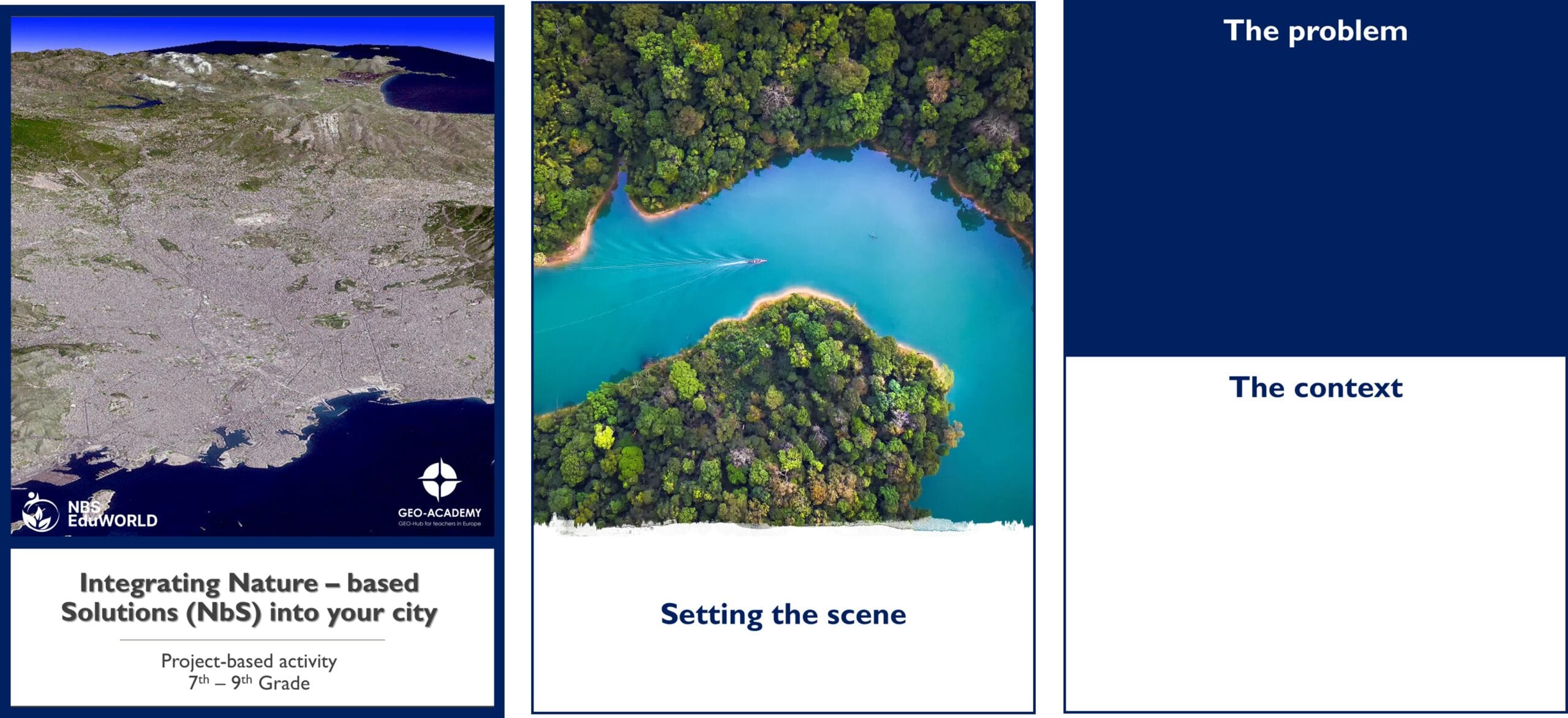
In this lesson, students will focus on Athens as a real-world case study to apply their knowledge of Nature-based Solutions (NbS). They will explore the city’s climate-related challenges, specifically areas that are vulnerable to heatwaves and flooding. The NbS Cards Game starts by sharing to students the first card of the game (see the right image below).
Their first task is to define the problem and contextualize it. Before we start, we spilt students into groups of 3-5! From now on, the students will work in groups until the end of the project!
1. Identifying the issues: Begin by clearly stating the main challenge your students will address. For example:
“Athens is increasingly vulnerable to the impacts of climate change,especially heatwaves and urban flooding. These risks threaten public health, infrastructure, and the well-being of citizens. Why is this happening and how NbS are related”
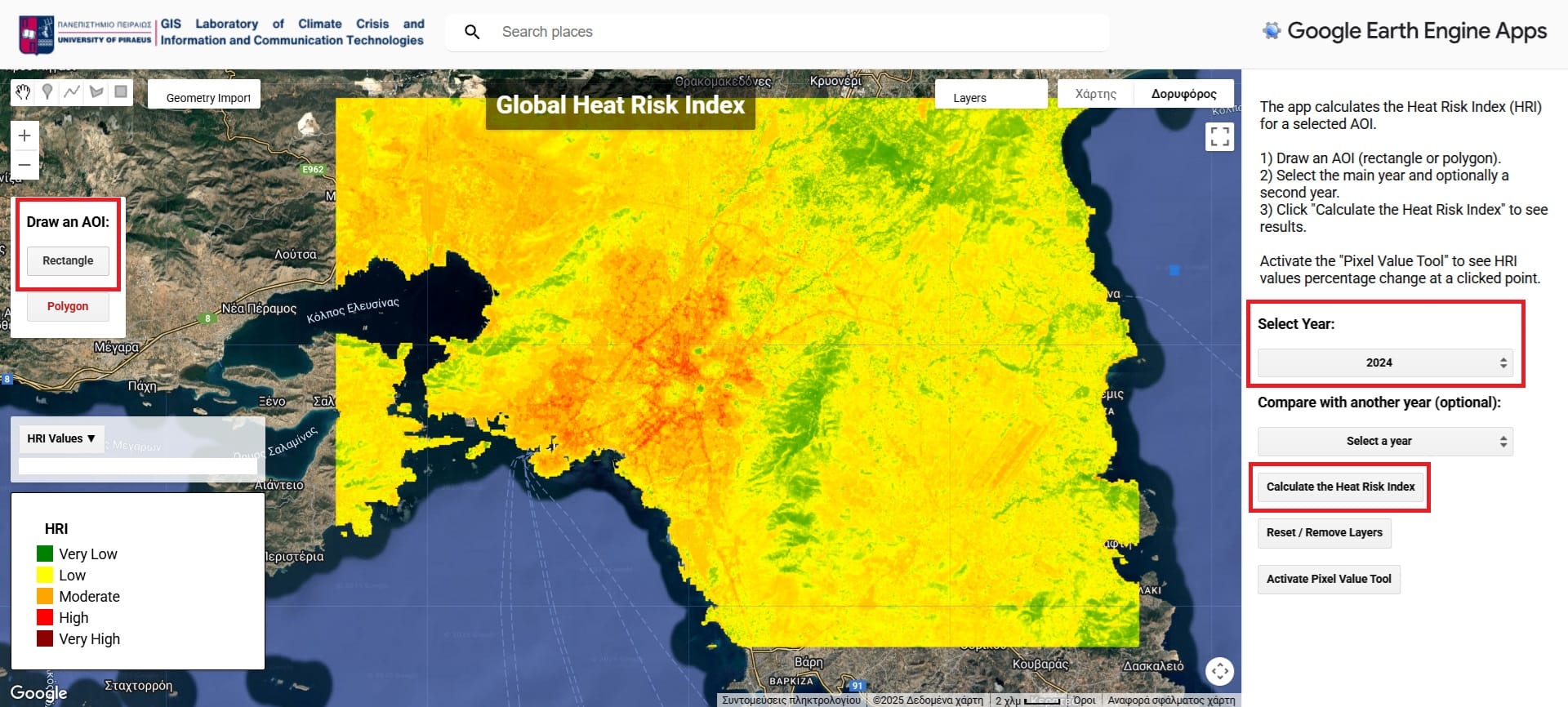
Using previously presented flood maps and the interactive Global Heat Risk Index web app, students will identify high-risk zones across Athens. This step sets the foundation for planning where NbS interventions could have the greatest impact—encouraging evidence-based thinking, spatial awareness, and critical analysis.
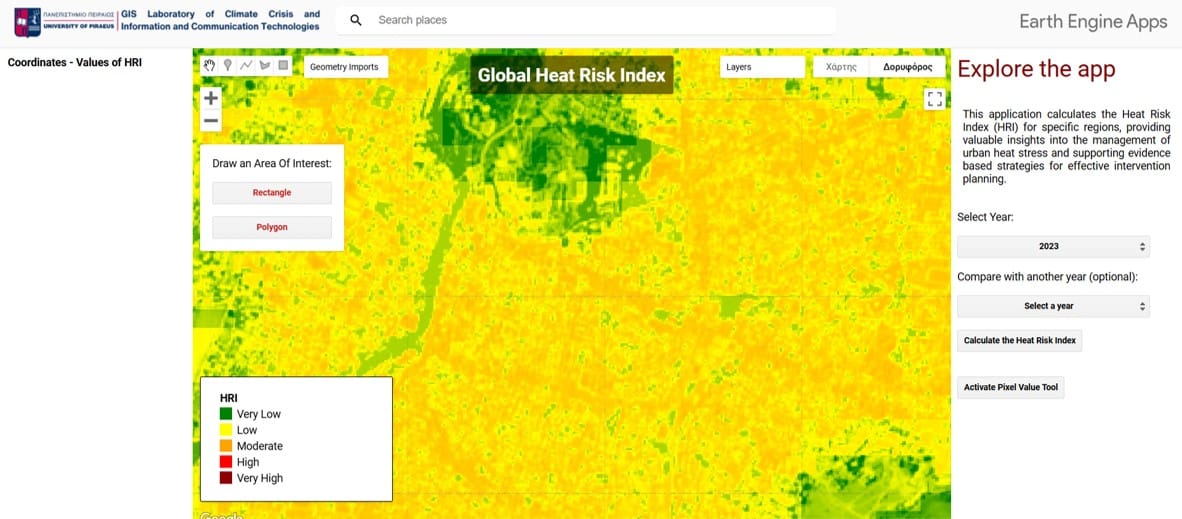
First, the students select the year and then the tool ‘Draw an Area of Interest’ > ‘Rectangle’ and they draw a polygon covering the city of Athens or any other city worldwide! Finally, they press ‘Calculate the Heat Risk Index’ and a new raster layer with the legend will appear! Red colors depict high-risk areas and yellow-green colors low-risk areas.
Our main goal is to identify high-risk areas (combined with the flood maps) and export them in .jpeg or .pdf format.
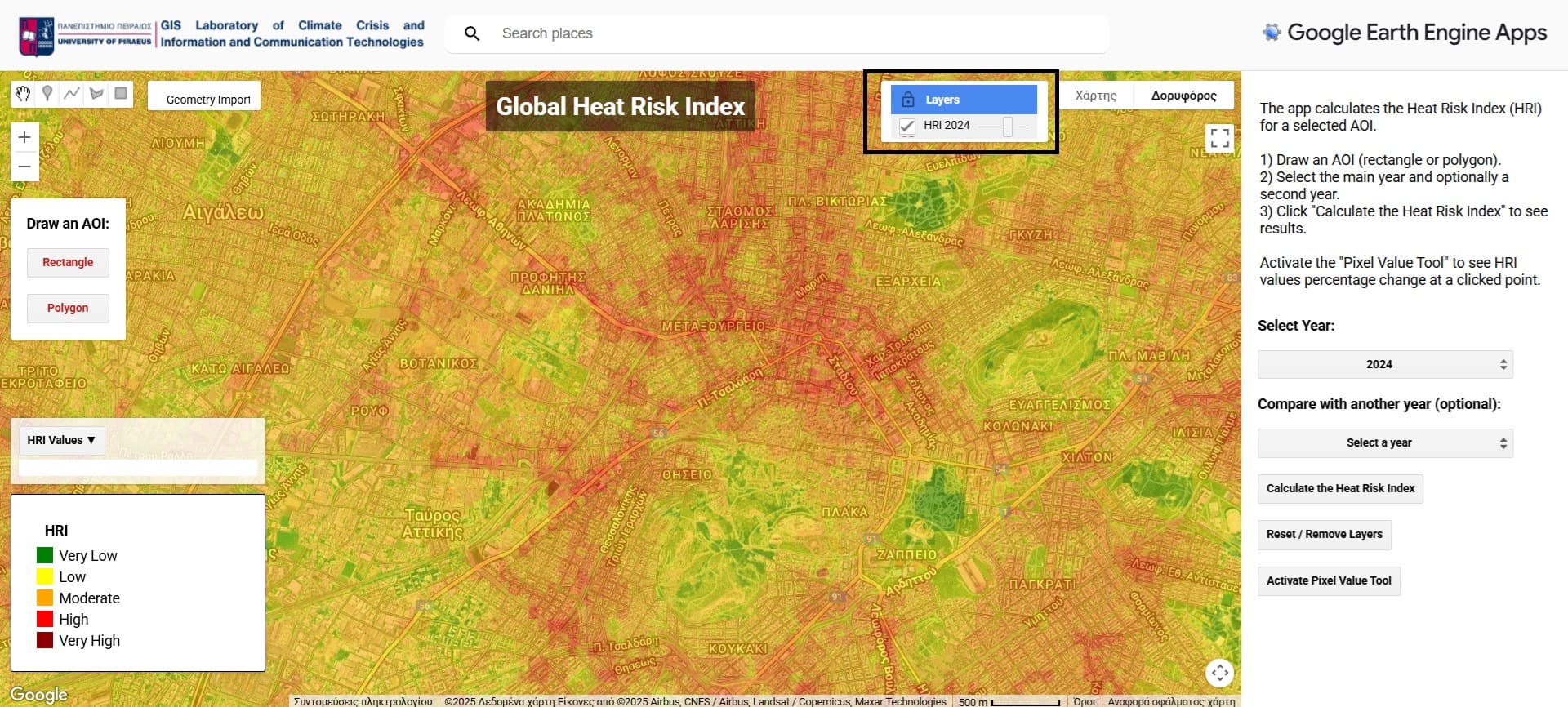
When we zoom-in, we can use the ‘Layer Transparency’ feature (see the image below) in order to identify which area is below our Heat Risk Index (HRI) map. We may use the ‘Pan’ button on the top-left toolbar to navigate on the map and explore different areas!
2. Set the Local Context
Help students understand why this problem matters here and now. Consider questions like:
- Which neighborhoods are most affected?
- What does the data show about heat exposure or flood risk?
- How does NbS contribute to reduce vulnerability?
The monitoring areas pahse consists of each group adopting/choosing a district without green areas, part of the abandoned city areas, such as: tree-lined avenues or undeveloped natural spaces to be worked on.
Let the students write down their thoughts and findings on the first card! (This card below)
3. Frame the Challenge with Purpose – Selecting a study area
Turn the problem into a guiding question or mission:
- “How can we use nature-based solutions to make Athens cooler, safer, and more resilient to extreme weather events? Let’s put it into practice by extracting any area you want!”
The next tool we will use is either ‘My Google Maps‘ or ‘Google Earth Pro‘. Keep in mind that if you use My Google Maps, there is no option to include a scale on the map which is critical for the measurements during next steps. Also, Google Earth Pro has a Graphical scale and not a Nominal scale, which ok, is helpful but a bit tricky if you are not familiar with such scaling schemes. However, the maps are a bit more impressive via My Google Maps!
My Google Maps
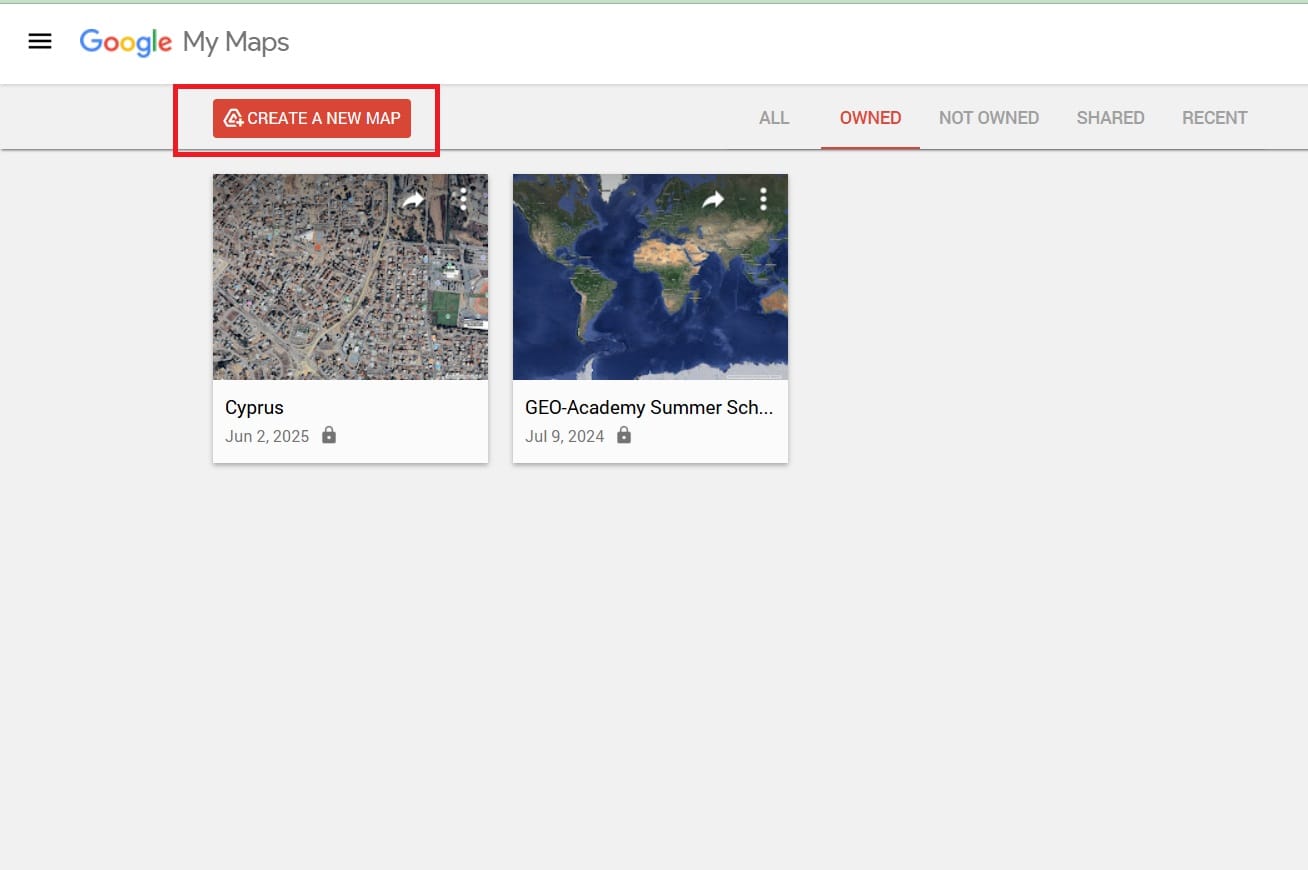
We first select ‘Create New Map’.
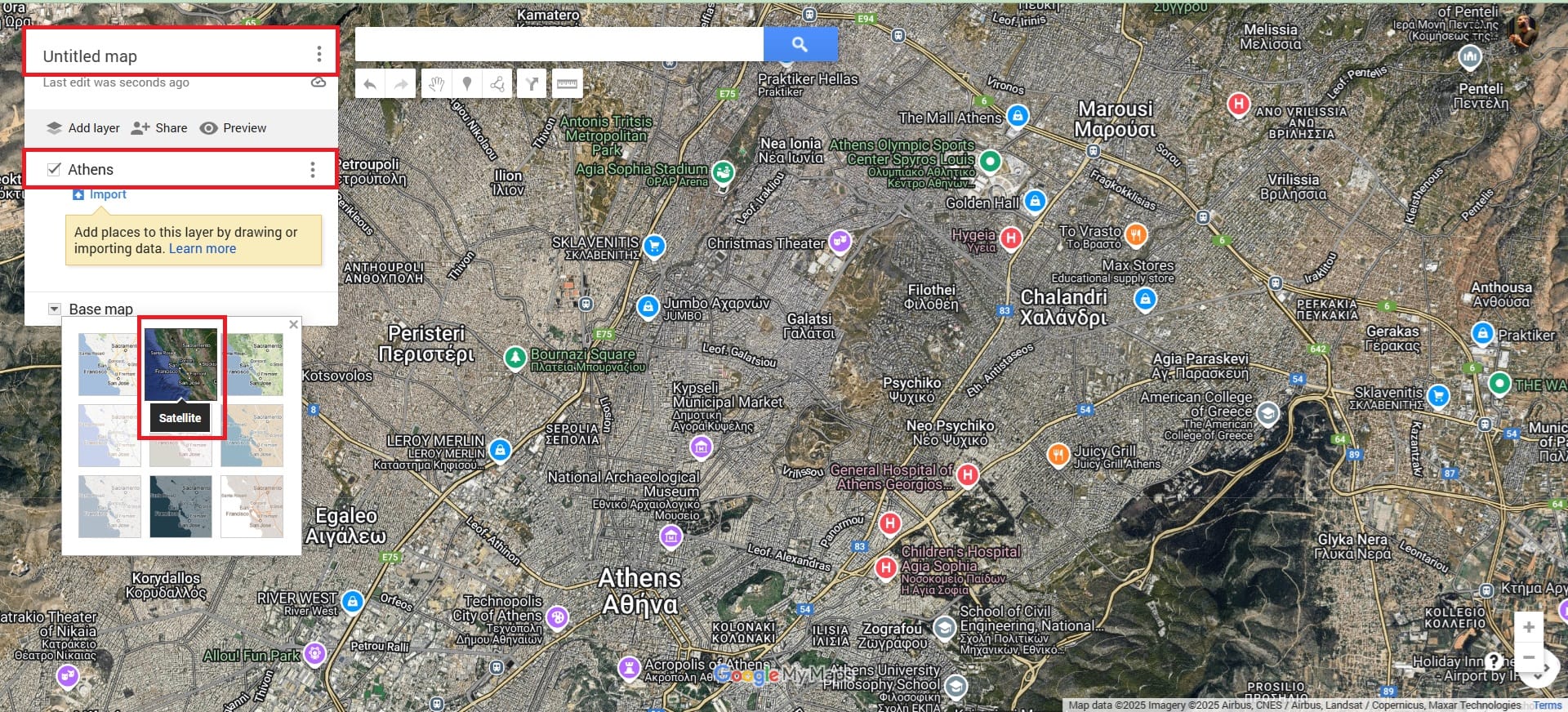
We give a name to our map (see the image below) and then we select a ‘Base Map’ > ‘Satellite’, so that we are able to see all buildings, streets and rooftops.
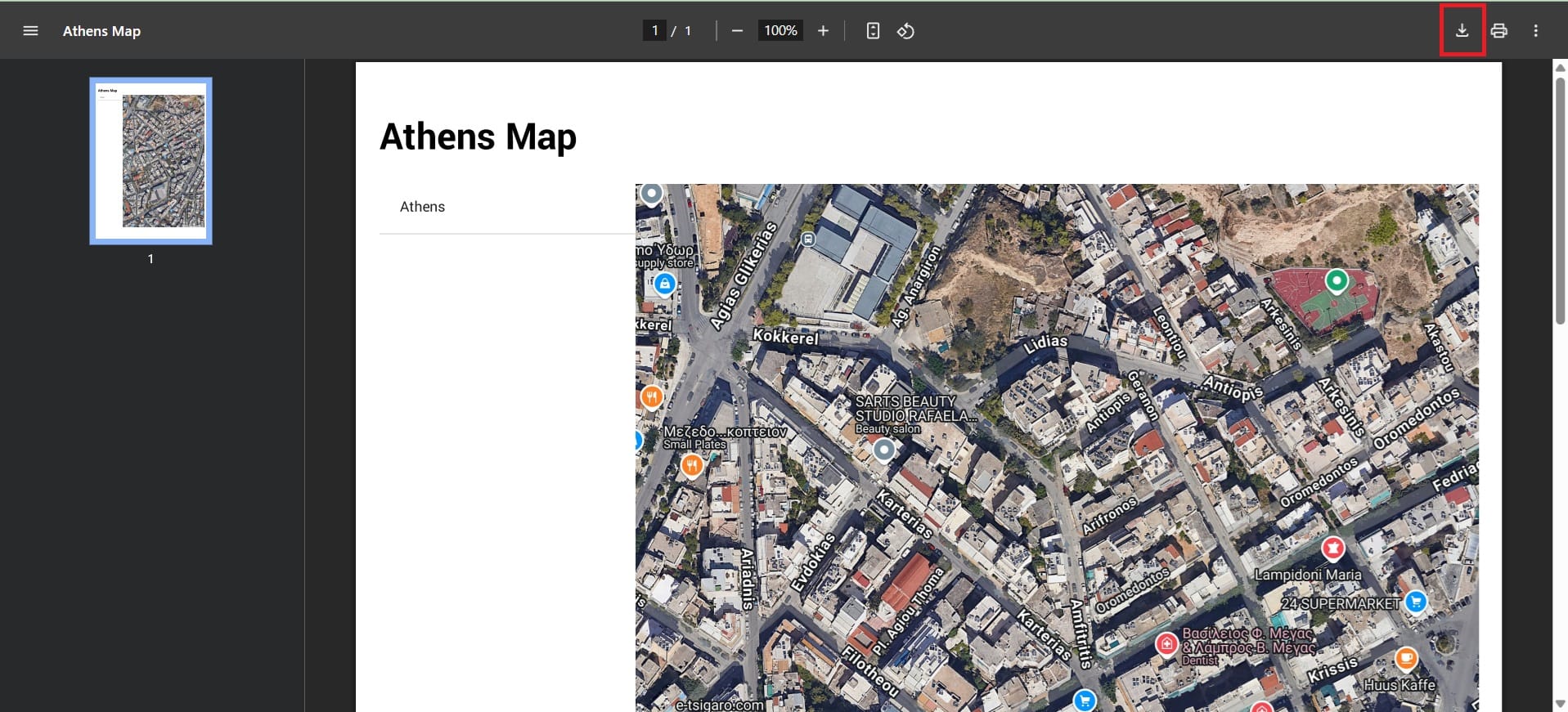
Then, we press the 3 dots icon on top, next to the Map name (not the Layer name) and we select ‘Print Map’. We select the size (i.e. A3 or A4), the orientation (portrait or landscape) and the file type as .pdf and we save our map. The bigger the printed map size (i.e. A2 or A3 size) the better for the students to work together on the map.
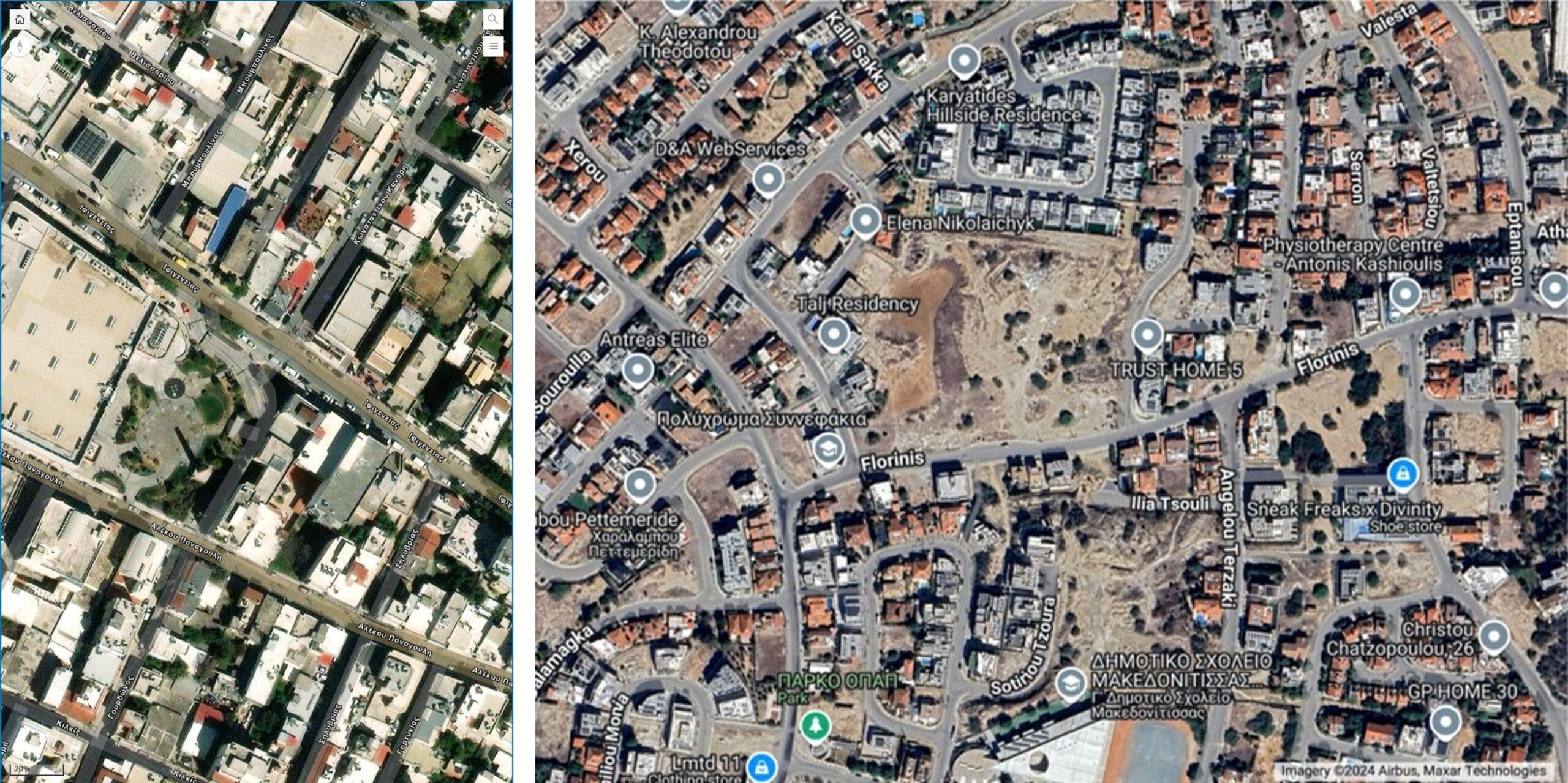
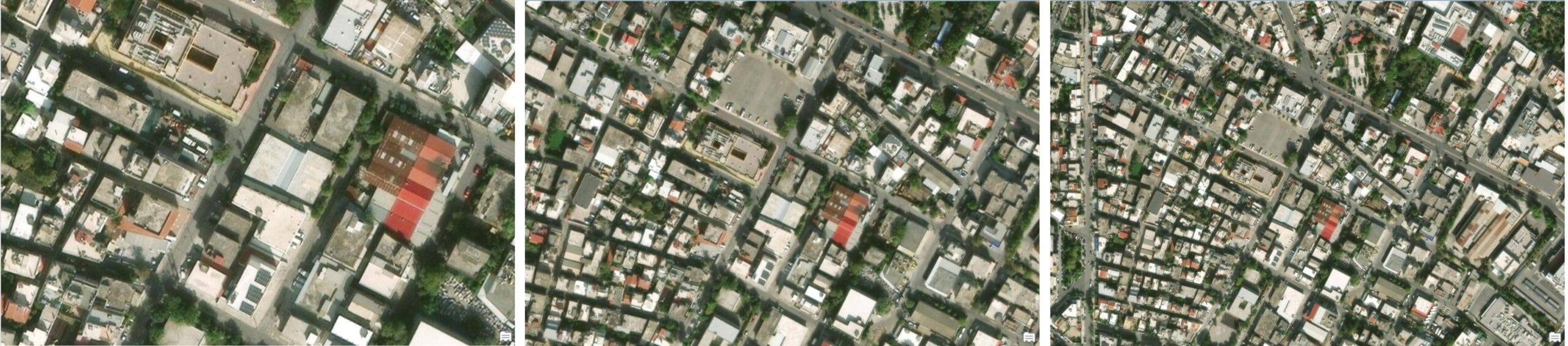
Keep in mind that the zoom-levels and the scales of the maps below are approximately 1:1000 to 1:3000 which means that 1 centimeter on the map is 1000 or 3000 centimeters in reality!
Scale 1:2000 (approximately) Scale 1:3000 (approximately)
Google Earth Pro
You just download the application, you open Google Earth Pro and you zoom-in to you area of interest. To print a map:
- Hide all layers and keep only the information you need (Layers tab: places, borders and terrain)
- Press the print icon on top (next to the envelope icon)
- Use map options to hide or enable features (i.e. legend, scale etc.)
- Edit map title and the legend
- Save as .pdf
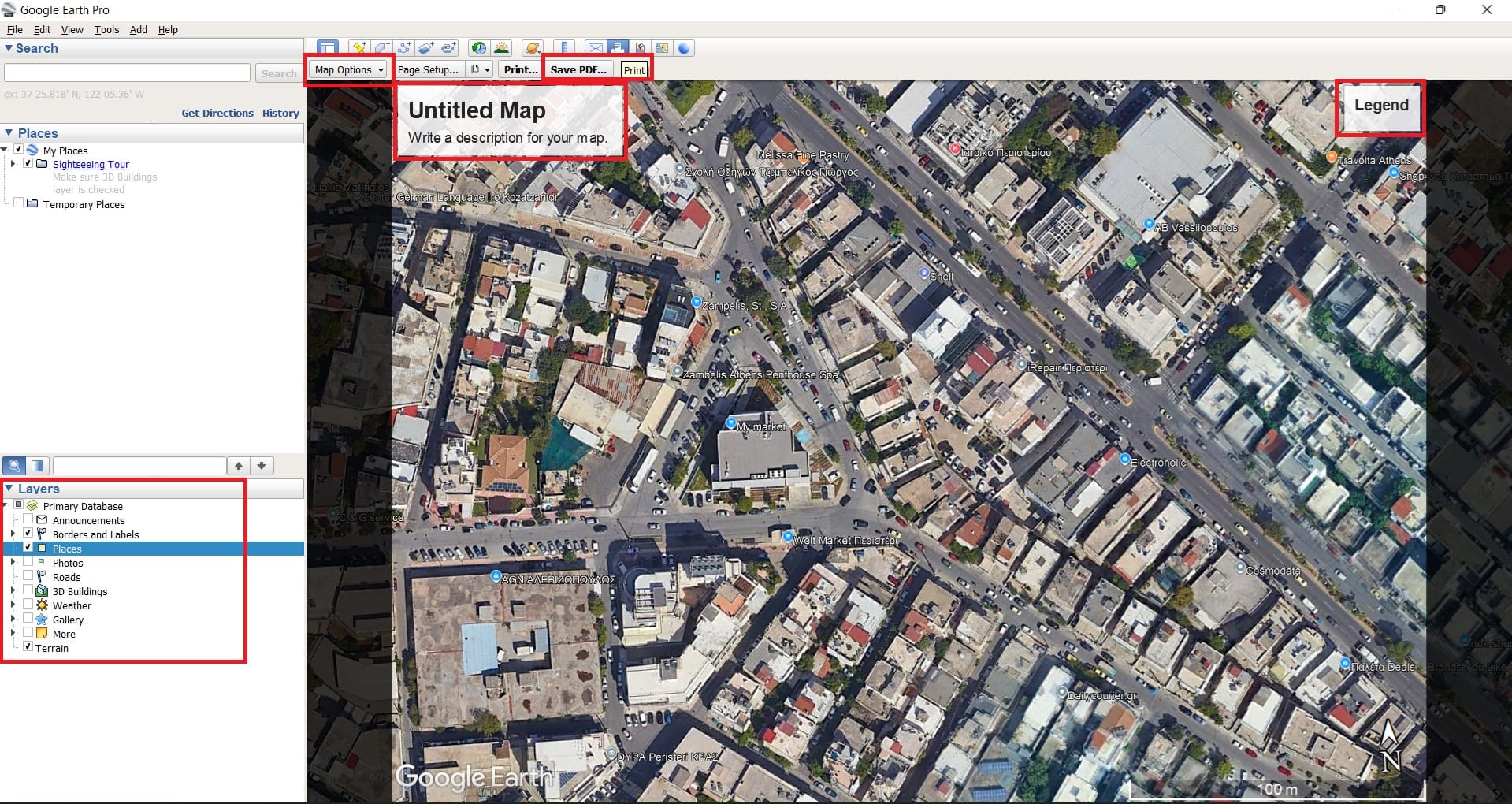
Still in Google Earth Pro, there isn’t a Nominal Scale, only the Graphical/Bar scale on the bottor-right corner (see the image above).
Just to have an idea of the zoom levels either on Google Earth Pro or My Google Maps, here is an example of the zoom level and the Nominal Scale that you’ll need for your calculations.
| Scale 1:1000 | Scale 1:2000 | Scale 1:3000 |
|---|---|---|
 |
||
That was it! We collect all maps and .pdf format and we are ready for the next step!
Lesson 6 (90 minutes): Setting the scene for the NbS concepts
After we have selected and printed all maps/areas, the first activity starts by introducing the NbS concepts that the students could potentially use. The second round of the NbS cards incorporates different NbS concepts, their description on the back of the card as well as the installation and maintenance cost with each concept’s super powers in the front of the card.
Usually, the first 10 NbS concepts may be used (slides 9 – 25 in the .pdf file attached on the lesson material) including:
- Forested green areas (we need some space to create those areas but it’s not impossible)
- Rain gardens (less space and they can be co-designed with the forested green areas)
- Urban Gardens (not so much space and we can event create our own inside school)
- Green roofs (easy to be constructed at a building level for bigger or smaller rooftops)
- Green Facades (for big buildings, i.e. entreprises, public authorities buildings, hotels, or our school)
- Roadside Trees (easy to be implemented BUT, FOR ACCESSIBILITY REASONS, WE NEED ENOUGH SPACE ON THE SIDEWALKS)
- Green Rails (i.e. for tram lines)
- Green Urban Furniture (cheap and easy in bus stops or existing parks)
- Permeable Surfaces (really really effective for sidewalks and parking areas)
- Rainwater Harvesting (either in houses, or our schoolyard)
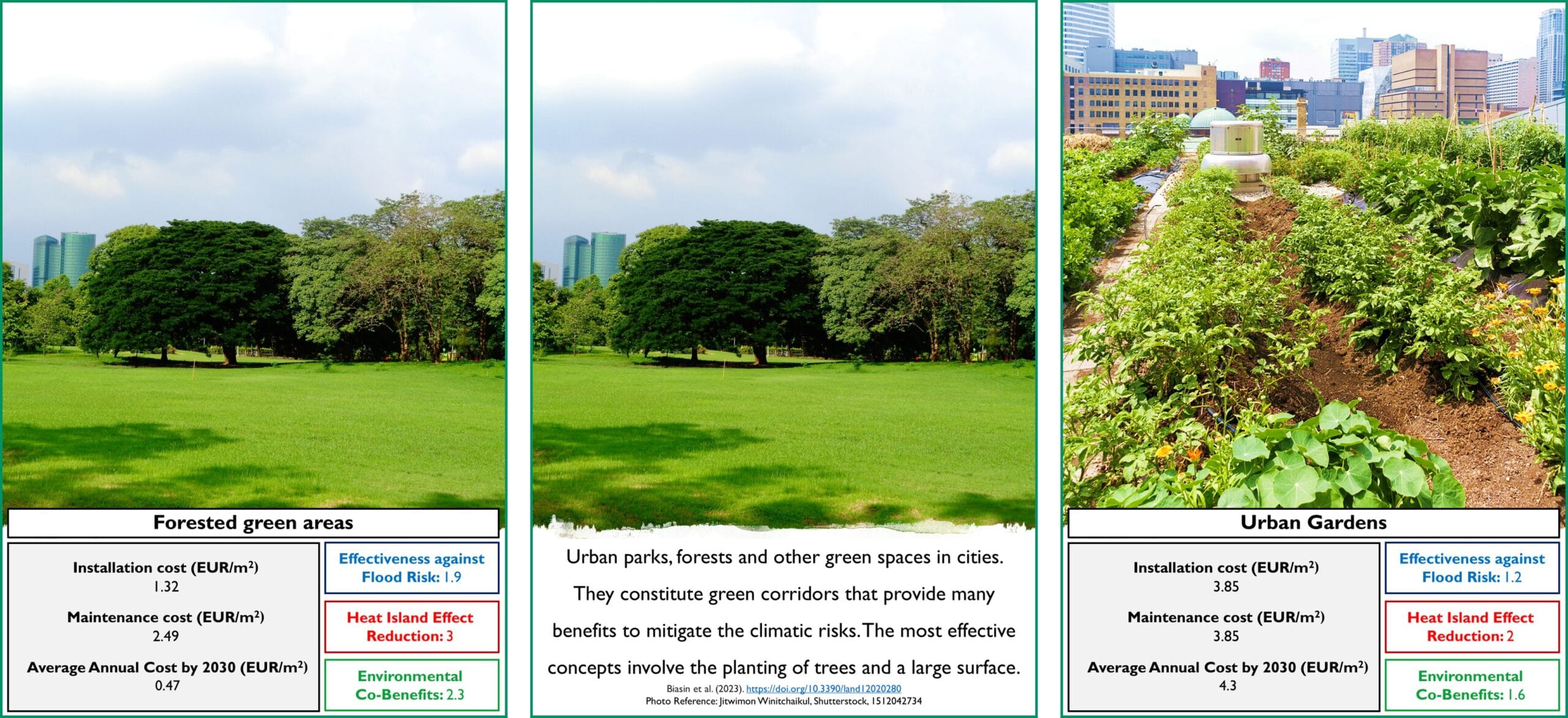
The students select based on the NbS concept, its super powers and the applicability, depending on the characteristics/buildings of their study area. Then, they have to estimate the costs!
To do that, they need 2 important measurements:
- The size/area of a rooftop, a street or an abandoned area
- The years that each NbS concept will be installed and maintained
To answer the first one, keep in mind that we have the maps and the scale (i.e. 1:2000)! This means that every centimeter they measure on the map is multiplied by 1000, 2000 or 3000 to find the actual length in centimeters. For example:
- A rooftop has a size of 8×10 = 80 square centimeters which equals to 160000 square centimeters if we have a 1:2000 scale. This equals to 16 square meters (160000/10000).
- If we check on the ‘Green Roofs’ card, the installation cost is 77.5 Euros/square meter and the maintainance cost is 55 Euros/square meter. The final cost will be, if we construct (one time) and maintain this concept for 25 years: (77.5 x 16) + (25 x 16 x 55) = 23240 Euros (approximately).
- If we install 10 green roofs in 10 houses, the cost increases to 232000 euros and if we want to include another 2-3 NbS concepts, then, a budget of 500 – 1000k Euros seems more than ok for each team.
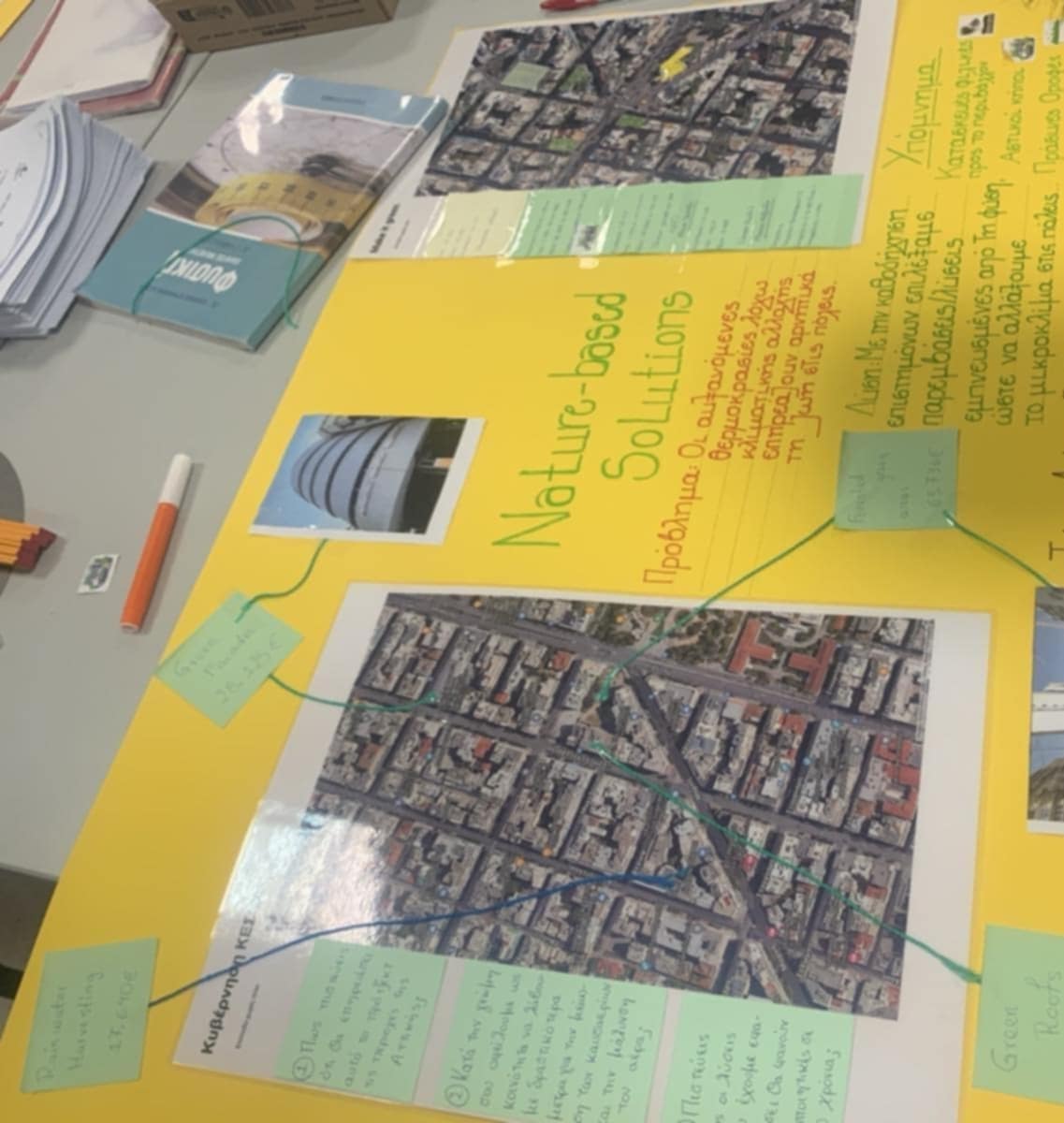
The students may use post-it cards to link different NbS concepts to the map, including the estimated costs and the benefits!
Lesson 6 (360 minutes): The prototyping game – Identifying challenges, prototyping ideas and societal actors
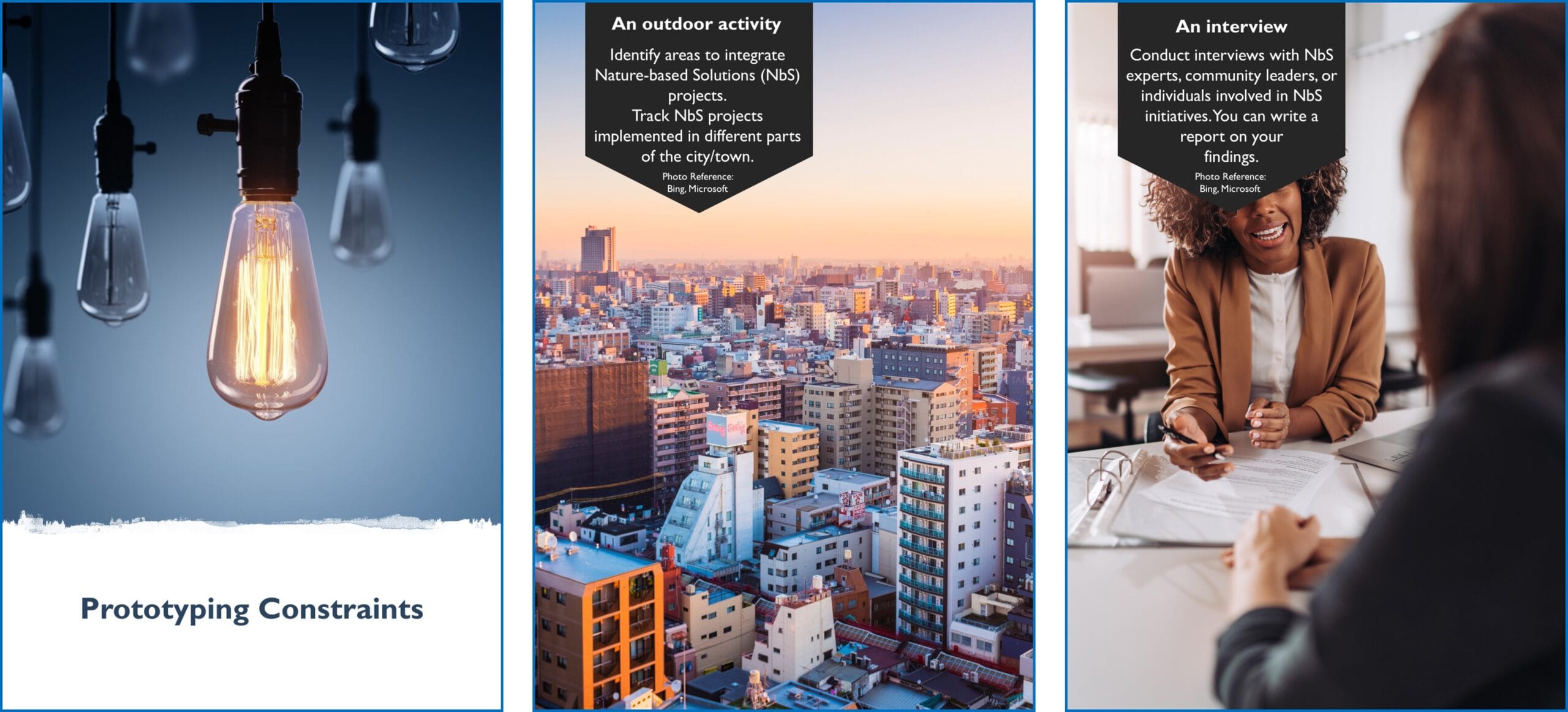
After completing the first phase of the NbS Cards Game, where students explored different nature-based solutions and identified climate-related challenges, they are now ready to step into the role of NbS experts. In the second phase, students begin to design a prototype—a tangible or creative output that communicates their proposed solutions, supported by collaboration with societal actors.
This phase transforms knowledge into action and encourages students to think creatively, communicate effectively, and work as part of a team tackling real-world issues. The prototyping ideas include:
- ✅ A poster campaign for an NbS fair or awareness event
- 🎤 Conducting an interview with an NbS expert (in person or online)
- 📊 Designing a survey to measure public willingness to adopt NbS in their neighborhood
- 🏗️ Creating a 3D printed model of a nature-inclusive building
- 🌐 Developing a website to showcase findings, proposals, or visual storytelling
- 🗣️ Organizing a community meeting with local stakeholders
- 📸Collecting photos, videos, or field data from the area they selected for intervention
- 💡 Compiling a set of challenge ideas or policy suggestions based on their findings
Contacting societal actors and co-designing
Throughout the prototyping process, students are encouraged to reach out to local experts and community members for support and inspiration. These actors help bring realism, depth, and diversity to their projects:
- 👨🌾 A farmer or soil expert for projects involving green roofs or community gardens
- 🥦 A nutritionist to advise on school or urban gardening projects
- 🏗️ An engineer to help conceptualize green facades or sustainable infrastructure
- 🌧️ An environmentalist for rain gardens and rainwater harvesting systems
- 🧪 A chemist or urban planner for permeable surfaces and materials
- 🏙️ A municipal officer or local authority for presenting and validating their ideas
- 📻 A local journalist, radio host, or newspaper for spreading awareness
- 📱 A marketing expert to help design a social media campaign for NbS
- 🎨 An artist to co-create posters or design a mural at school
- 👨👩👧👦 Their family members—for collecting experiences, knowledge, and brainstorming together
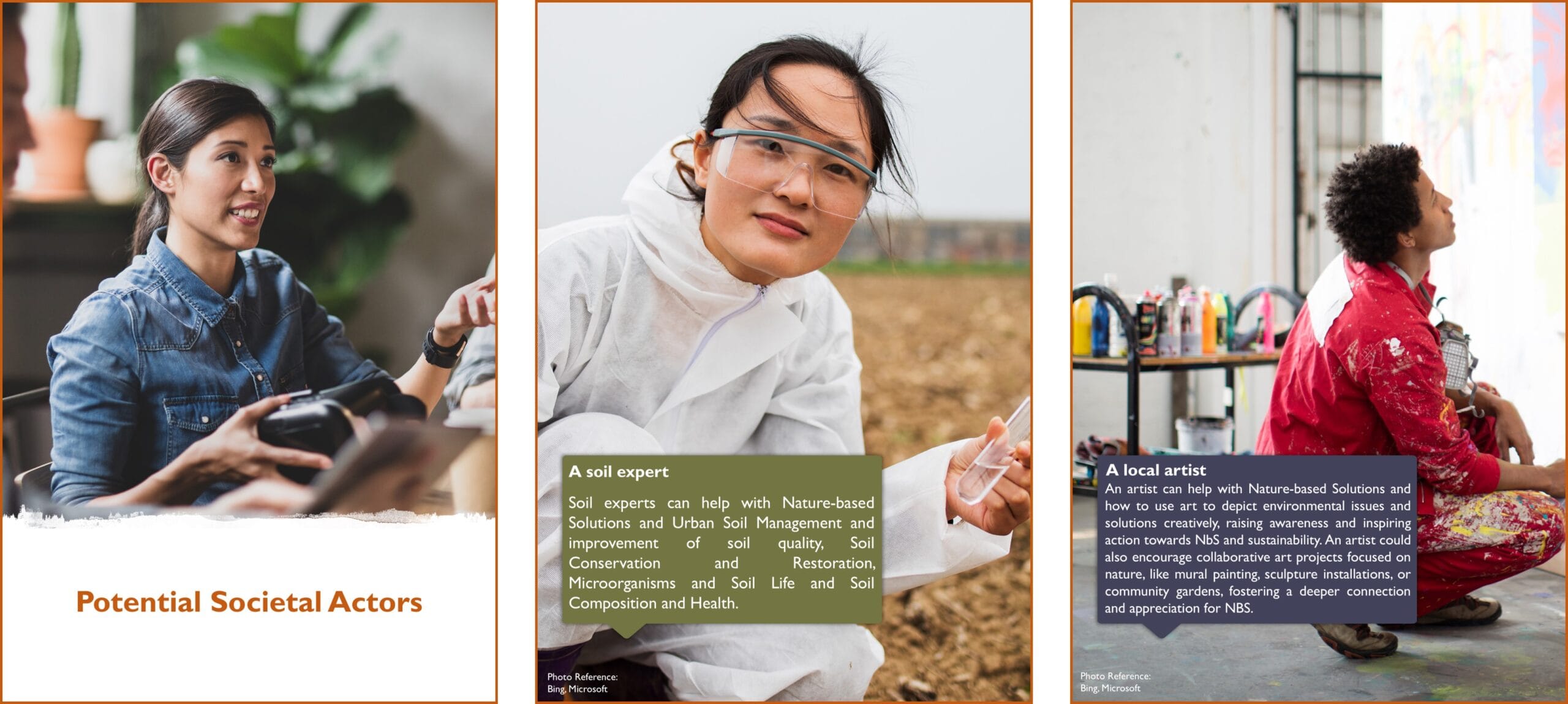
By involving these actors, students gain real-world insights, strengthen their communication and teamwork skills, and begin to see themselves as active citizens shaping sustainable urban futures through Nature-based Solutions. 🌿🏫🧠
To start our endeavor on identifying potential societal actors or people who may help us, we follow the methodology of the image below. We work in circles and each week we ‘unlock’ a new circle of potential help and interaction with people inside and outside our school.
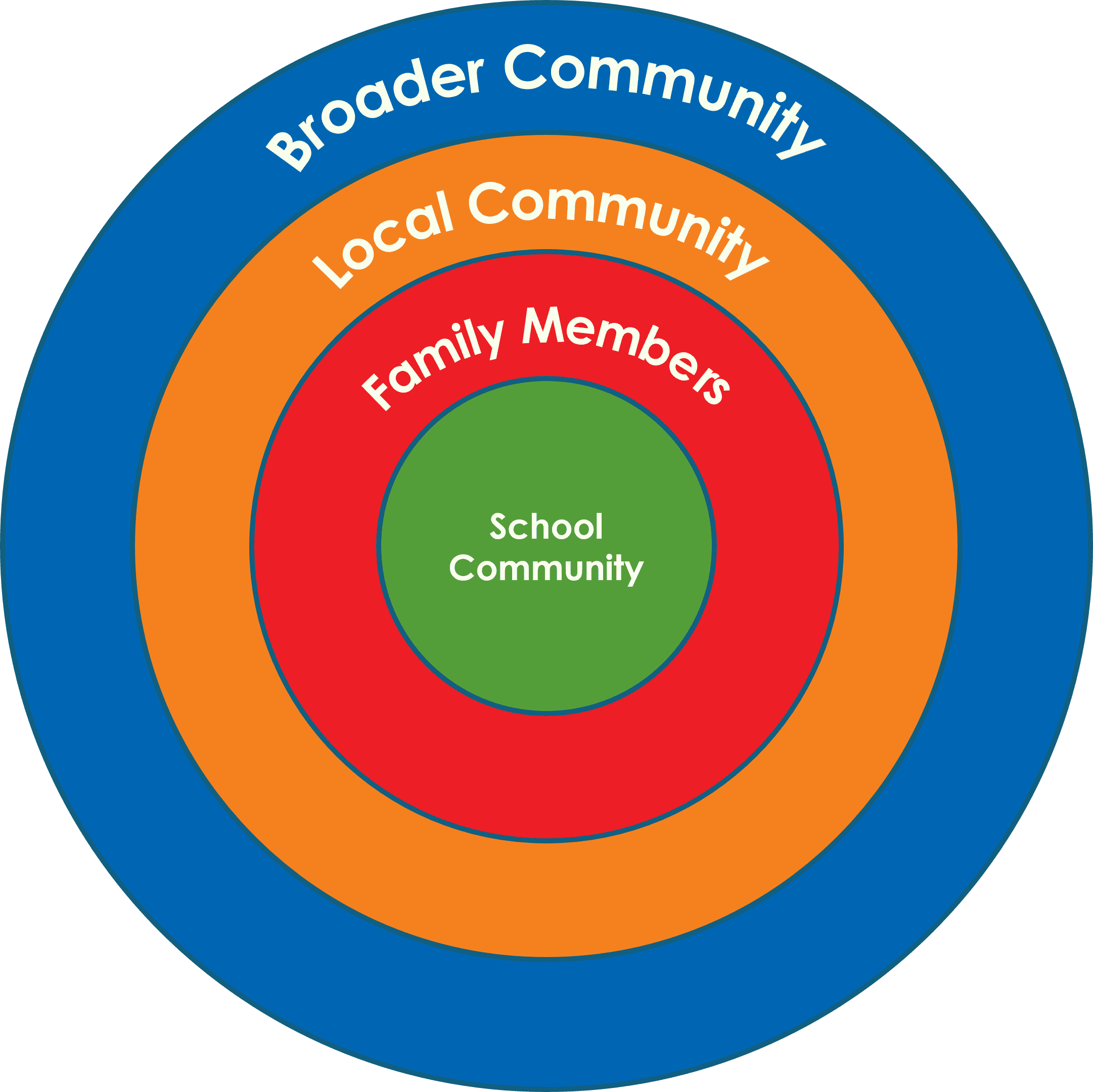
🔍 Finding Support for Prototyping – From the Inside Out
🎓 1. School Community: This is the students’ starting point. They can seek guidance and feedback from:
- Teachers
- Classmates
- School staff (e.g., science or geography teachers, school headmasters)
- School clubs or eco-groups
These actors are the most accessible and provide immediate support for planning, testing and communicating our ideas.
🏡 2. Family Members: Encourage students to bring their ideas home and involve:
- Parents or guardians
- Siblings
- Grandparents
- Extended family members
Family members can contribute knowledge, feedback, or even help gather stories and experiences that relate to the NbS challenge. Family members might have an expertise on farming, egineering, nutrition, social media, arts, environment and climate change etc.
🏘️ 3. Local Community: At this level, students reach out to individuals and organizations in their neighbourhood:
- Local farmers or gardeners
- Environmental NGOs
- Business owners
- Municipal departments (e.g., urban planning, public works)
- Local media (radio, newspapers)
These actors help students connect their solutions to real-world local contexts. How? Either by visiting local actors or by contacting them via e-mail or a teleconference. Of course, the best case scenario is to invite them at school!
🌍 4. Broader Community: The outermost circle represents actors at the regional, national, or even international level. Here, students might collaborate with:
- University researchers
- Scientists and engineers
- Policy experts
- Climate resilience professionals
- Social media experts
These societal actors bring expertise, broader insight, and inspiration, and help validate student ideas with professional-level feedback. Feel free to contact them as a group or even invite them to your school to exchange ideas and seek for their expertise.
🌱 Why This Model Matters
This layered approach teaches students that creating sustainable, impactful solutions isn’t something they have to do alone. It models collaborative learning, encourages active citizenship, and reinforces the value of multi-stakeholder dialogue, as a core principle in education for sustainable development. Let your students use this model as a guide to map out their support network, from the classroom to the global community. 🌐🤝📚
Lesson 7 (90 minutes): Students’ reflection – Finalizing the prototypes
This final session of the NbS Card Game activity marks the transition from design to presentation, giving students the opportunity to reflect, finalize, and share their NbS projects. After days of collaborative learning, critical thinking, and hands-on prototyping, this lesson allows students to consolidate their insights and communicate their ideas creatively and effectively.
✅ Key Objectives: Reflect on their learning pathway: What challenges did they face? What did they discover about NbS, their community, and themselves? Finalize their project outputs, which may include:
- 🎨 Awareness-raising posters or infographics (i.e. the ones they created during the first phase of the game)
- 📝 Informative reports or illustrated booklets
- 🧪 Hands-on models (e.g. green buildings, mini urban gardens)
- 📢 Social media or school campaigns
- 🎬 Short video presentations, interviews, or digital storytelling (you may also check the ‘Map Storytelling’ course on how to create engaging and informative storymaps)
🧠 Reflective Practice: Start the session by prompting students to reflect individually and as a group:
- What was the most surprising thing they learned about NbS?
- How did working with external actors help shape their ideas?
- What would they change if they had more time?
- How do they see their role in improving their school or city with NbS and how NbS-friendly is their city right now?
You can use tools like digital reflection walls (e.g. Padlet, Jamboard), sketchbooks or roundtable discussions.
📢 Sharing the Prototypes: After finalizing their outputs, allocate time for students to present their NbS prototypes to:
- Their classmates
- Other classes or school visitors
- Parents and family members
- Local community partners or even external experts (in person or virtually)
Consider organizing an NbS Fair (2-3 days) or “NbS Living Lab Showcase”, where each group sets up a booth to explain their concept, challenges, and results. This adds value to the process by recognizing students as young change-makers contributing to a more sustainable future.
🌍 Beyond the Classroom: Finally, encourage students to think about how their ideas could live on beyond the lesson:
- Could they send their ideas to the local municipality?
- Might they write a letter to a real societal actor (i.e. the city Mayor) or publish their campaign online?
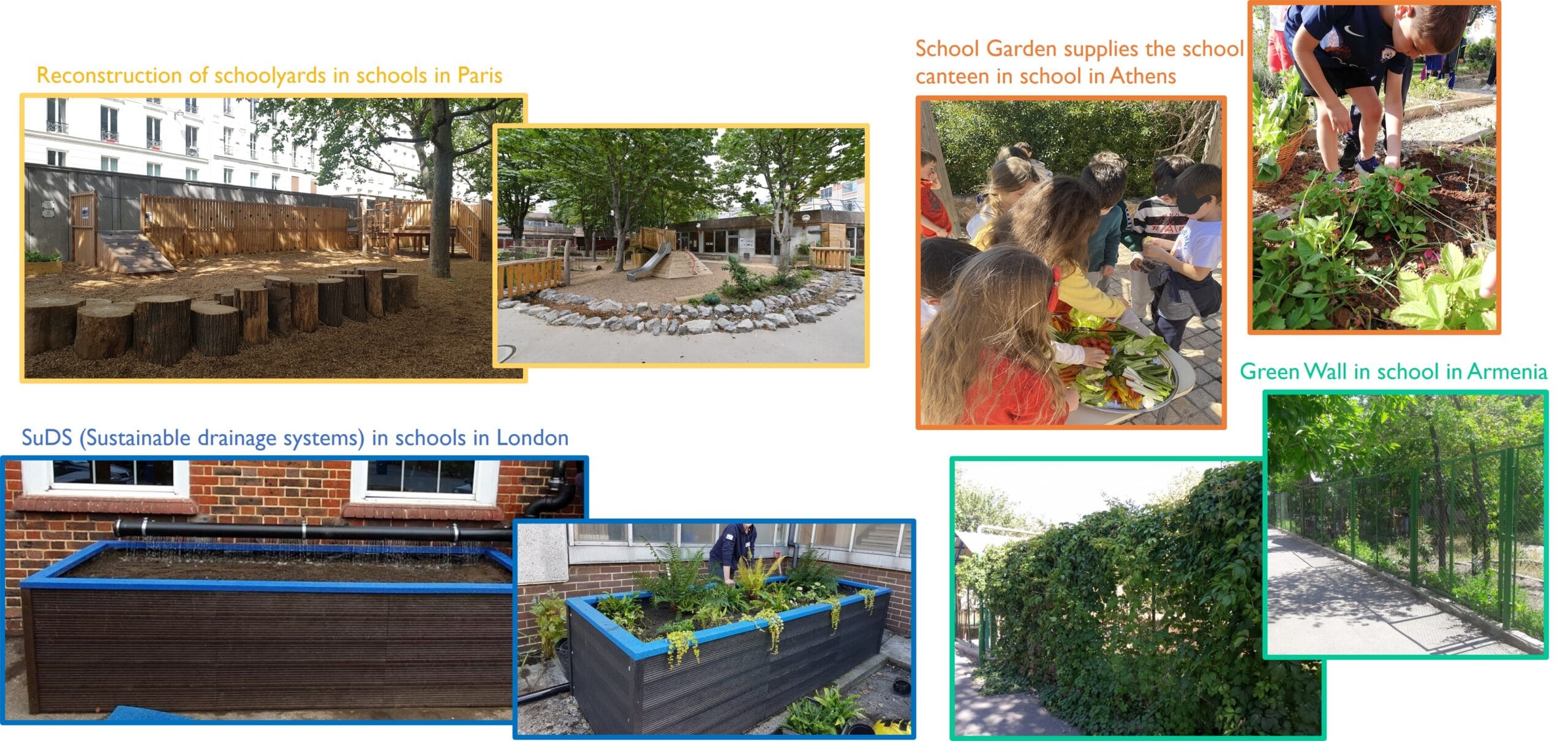
- The students may initiate a campaign for integrating NbS concepts in their school. Is it possible? Check the photo below!
This lesson isn’t just the end of the activity, it’s a launchpad. Through creativity, teamwork, and real-world engagement, students emerge as active citizens ready to design nature-inclusive, resilient cities. Feel free to adapt the activity not only for NbS but for other sustainability topics as well 🌳💡📢!
Useful links
- European Research Executive Agency: Nature-based solutions
- UPSurge Project: Nature-based Solutions and Cities
- IUCN: Nature-based Solutions
- NBS EduWORLD: Nature-Based Solutions Education Network
- NetworkNature EU: Nature-based Solutions Community
- NBS Academy: Training and Teaching Resources for NBS
- Ellinogermaniki Agogi: Nature-based Solutions for Climate Resilience
- Bathrellos, G.D., Karymbalis, E., Skilodimou, H.D. et al. Urban flood hazard assessment in the basin of Athens Metropolitan city, Greece. Environ Earth Sci 75, 319 (2016).
- Athens Social Atlas: Natural hazards and climate change risks in Athens
- Bournas, A., & Baltas, E. (2025). Flood Hazard Assessment Using Weather Radar Data in Athens, Greece. Remote Sensing, 17(1), 72.
- WWF: Urban Nature-based Solutions – Cities Leading the Way 2021