
Have you ever felt the ground move beneath your feet, without knowing exactly what caused it? That brief moment of uncertainty can be both frightening and fascinating. Beneath the Earth’s calm surface, enormous forces are constantly at work. Tectonic plates push, pull, and rub against each other slowly, storing energy that is suddenly released in the form of seismic waves. When these waves reach the surface, they make the ground shake, sometimes gently, sometimes violently. Even when we don’t feel them, small vibrations are constantly happening around us, caused by construction, traffic, or even footsteps in a hallway.
Introduction to Seismology and Earth Vibrations.
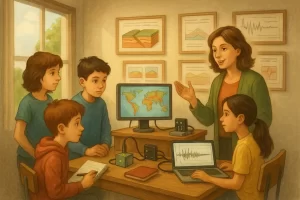
Illustration of students exploring how seismic activity is detected and measured through tools such as
sensors, seismographs, and tectonic plate maps. The scene highlights curiosity, scientific inquiry,
and the invisible forces shaping the Earth’s surface.Credits: Custom educational illustration created for the course
Earth Vibrations: Understanding Seismic Waves with Micro:bit Sensors, generated by an AI model..
Understanding these invisible movements is essential for scientists, engineers, and communities. It allows us to monitor the stability of buildings, predict potential risks, and develop early warning systems that save lives. Seismology, the science that studies earthquakes and vibrations, helps translate these invisible signals into data that can be analyzed and visualized. With technological advances, tools once used only in large research centers, such as accelerometers and sensors, are now available in educational kits like the Micro:bit, allowing students to explore the same principles that professionals use to detect earthquakes.
Curriculum
- 1 Section
- 4 Lessons
- 10 Weeks
- Building a SeismometerThis section introduces the scientific foundations of seismology and guides learners in understanding how ground vibrations can be detected, measured, and interpreted. Through inquiry-based activities, students explore how a Micro:bit can function as a miniature seismometer, linking physics, earth sciences, and digital technologies.5
